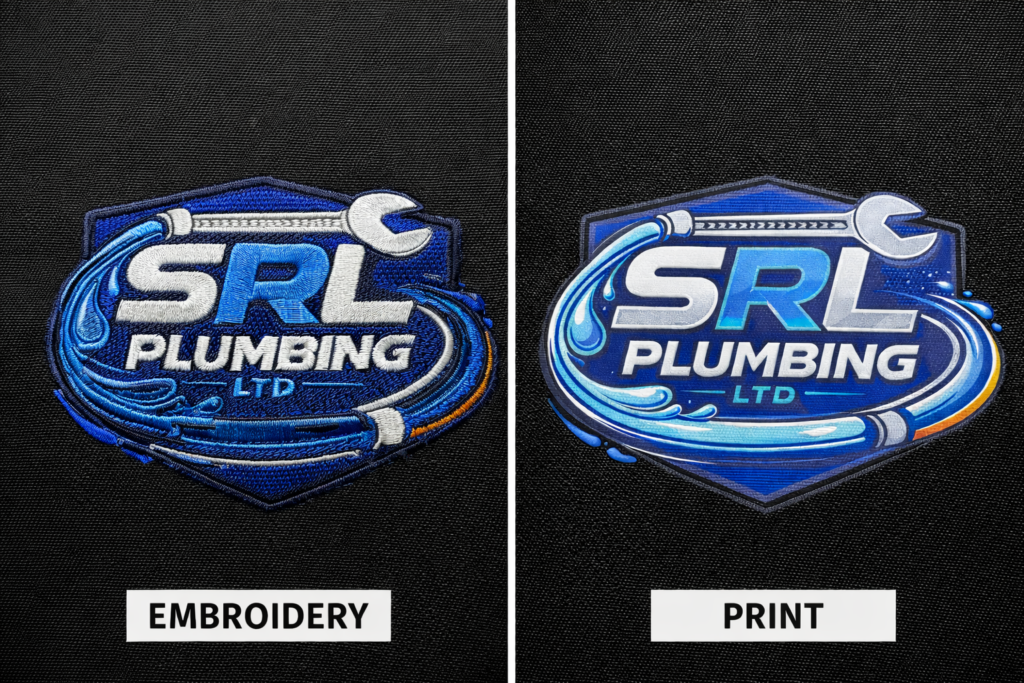


Print vs embroidery for workwear is one of the most common questions businesses ask when ordering branded uniforms.
Both methods work. Both have advantages. But choosing the wrong one for your garments, industry or budget can cost you in the long run.
Here’s the straight breakdown so you can decide properly.
What Is Embroidery on Workwear?
Embroidery is your logo stitched directly into the garment using thread — ideal for businesses looking for durable, professional workwear embroidery.
It’s durable, textured and gives a premium, professional finish. You’ll typically see embroidered logos on polos, fleeces, jackets, shirts and caps.
When Embroidery Makes Sense
- Daily uniforms worn long term
- Trades, construction and logistics teams
- Corporate polos and outerwear
- Businesses wanting a premium look
Embroidery doesn’t crack, peel or fade like surface decoration can. It’s stitched into the fabric, so it lasts the lifetime of the garment.
The trade-off? It’s not ideal for large back logos or very detailed gradient designs.
What Is Printed Workwear?
Printed workwear involves applying your logo to the surface of the garment using methods such as screen print, vinyl or digital print.
It’s often the better option for bold branding, larger designs and promotional clothing.
When Print Makes Sense
- Large back logos
- Event t-shirts
- Gym and promotional wear
- Bigger quantity orders
- Designs with lots of colour or detail
Print allows more flexibility in size and design. It’s usually more cost-effective for larger prints and higher volumes.
However, it won’t typically outlast embroidery on heavily used uniforms.
Print vs Embroidery for Workwear: Which Lasts Longer?
If durability is your priority, embroidery wins.
Because it’s stitched into the garment, it handles repeated washing and heavy wear better — especially on work polos, fleeces and jackets.
Printed workwear can still last well when applied properly to quality garments, but over time it may fade or show wear, particularly with industrial washing.
If your team wears uniform five days a week, embroidery is often the safer investment.
Which Looks More Professional?
For most industries, embroidery gives a more premium and established appearance.
If you’re in construction, engineering, facilities management or corporate services, embroidered logos usually create the right impression.
Print works well for creative brands, gyms, hospitality businesses or companies wanting a more modern, bold look.
The right choice depends on your brand image and the message you want to send.
What About Cost?
When comparing print vs embroidery for workwear, cost depends on three things:
- Logo size
- Order quantity
- Garment type
Small embroidered chest logos are often very cost-effective for uniforms.
Large embroidered back designs can become expensive — this is where print usually makes more commercial sense.
For high-volume orders like event t-shirts, print typically reduces the price per garment.
For long-term uniforms, embroidery often gives better value over time.
Does Garment Type Matter?
Yes. A lot.
As a general rule:
- Polos, shirts, fleeces and jackets → Embroidery
- T-shirts, hoodies and promotional wear → Print
- Hi-vis garments → Often a combination of both
Fabric weight and texture influence the result. Lightweight garments tend to suit print. Heavier garments handle embroidery better.
Can You Combine Print and Embroidery?
Absolutely — and often that’s the smartest option.
A common setup is:
- Embroidered logo on the chest
- Printed large logo on the back
This gives durability where it matters and visibility where it counts.
Many businesses choose this blended approach once they understand the strengths of each method.
So, Print or Embroidery?
The print vs embroidery for workwear decision comes down to:
- How often the garments will be worn
- How frequently they’ll be washed
- Whether visibility or longevity matters more
- Your industry standards
- Your budget
There isn’t a universal answer. There’s only what makes sense for your business.
If you’re unsure, don’t guess. Choosing the wrong decoration method is more expensive than choosing the right one from the start.
We’ll look at your logo, garments, team size and budget, then recommend what actually fits your situation.
Because good workwear should work hard — not need replacing six months later.